KitchenAid vs Cuisinart Stand Mixer: The Ultimate Comparison
The real gap between a tilt-head and a bowl-lift stand mixer comes down to bowl capacity and how much dough the motor can handle. When comparing a KitchenAid mixer vs Cuisinart mixer, the choice often reflects a preference for brand heritage, motor design, and attachment versatility. For most home bakers seeking a reliable, durable, and highly expandable machine, the KitchenAid Artisan Series 5 Quart Tilt Head Stand Mixer is the clear winner, offering a superior balance of power, build quality, and an extensive range of accessories.
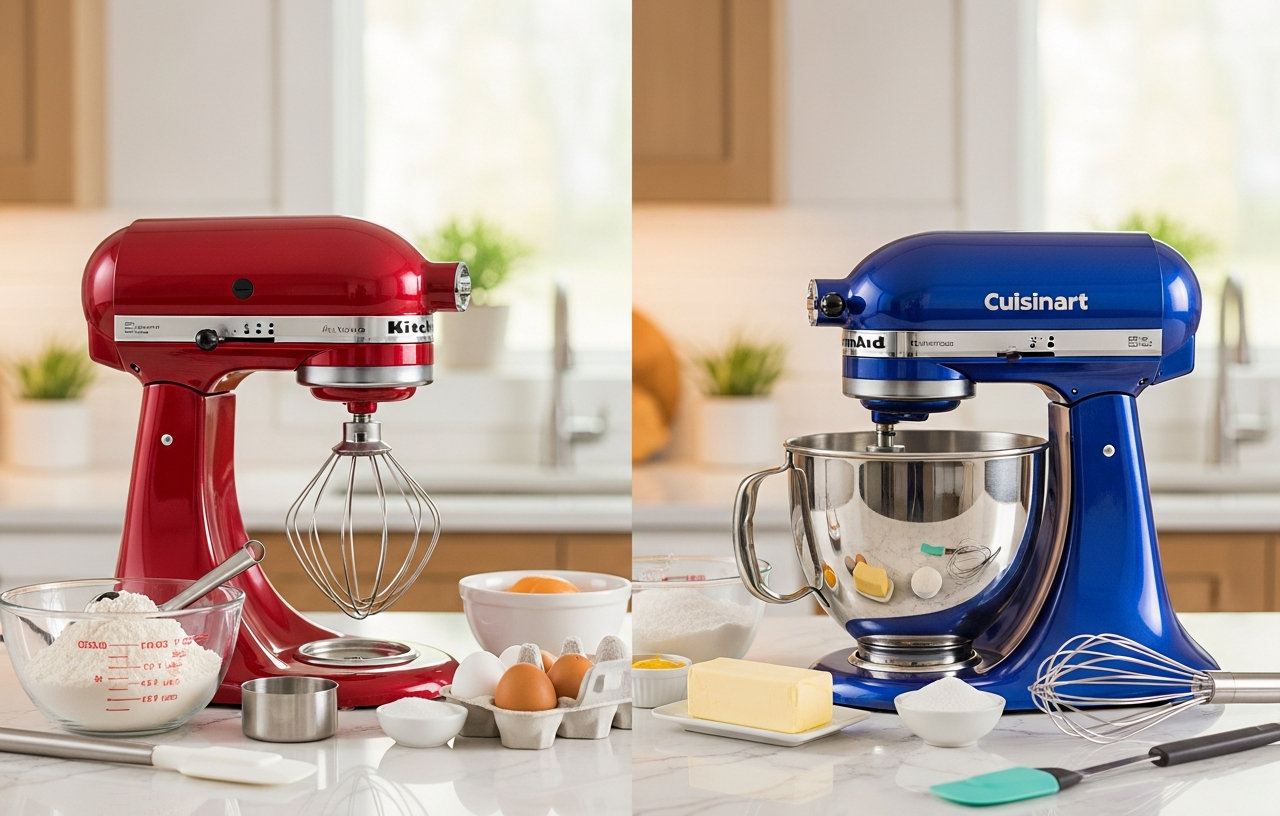
Many home cooks wonder, "Which is better, KitchenAid or Cuisinart stand mixer?" KitchenAid has long been the gold standard, recognized for its iconic design and robust performance. Cuisinart, while newer to the stand mixer market, has made a strong impression with powerful motors and competitive features. This article breaks down the strengths and weaknesses of popular models from both brands, including the KitchenAid Artisan, KitchenAid Classic, and the Cuisinart SM-50FR.
Key Differences: KitchenAid Mixer vs Cuisinart Mixer
Understanding the fundamental distinctions between a KitchenAid stand mixer vs Cuisinart stand mixer helps clarify which model best fits your baking style. These differences extend beyond aesthetics to affect performance, longevity, and overall user experience.
Motor Power and Type
KitchenAid stand mixers, particularly the tilt-head models like the Artisan and Classic, often use AC (alternating current) motors. These motors are known for their efficiency and consistent torque, especially at lower speeds, which is important for kneading dough. They typically range from 275 to 325 watts for tilt-head models. Cuisinart mixers, such as the SM-50FR, often boast higher wattage, frequently featuring 500-watt motors. This higher wattage can translate to more raw power, potentially making quick work of very stiff doughs or large batches.
Build Quality and Design
KitchenAid is renowned for its all-metal construction, which contributes to its exceptional durability and stability during operation. The classic, timeless design has remained largely unchanged for decades. Cuisinart models also use die-cast metal construction for critical components, offering good stability. Both brands feature tilt-head designs for easy access to the bowl and attachments, a practical feature for everyday baking.
Attachment Ecosystem
Perhaps the most significant differentiator between a Cuisinart versus KitchenAid mixer is the attachment hub. KitchenAid's universal power hub is a major selling point. It accommodates over a dozen specialized attachments, from pasta makers and meat grinders to spiralizers and ice cream makers. This expandability transforms the stand mixer into a versatile kitchen appliance. Cuisinart also offers optional attachments, but their range is generally more limited compared to KitchenAid.
Bowl Capacity and Design
Bowl capacity is a practical consideration. The KitchenAid Artisan Series offers a 5-quart stainless steel bowl, while the Classic Series features a 4.5-quart bowl. The Cuisinart SM-50FR comes with a 5.5-quart polished stainless steel bowl. Larger bowls allow for bigger batches of dough or batter, reducing the need for multiple mixing cycles. Both brands offer stainless steel bowls that are generally dishwasher safe.
Comparison Table: KitchenAid Stand Mixer vs Cuisinart Stand Mixer
Here's a side-by-side look at some core specifications to help you compare the KitchenAid vs Cuisinart stand mixer options directly.
| Feature | KitchenAid Artisan Series 5 Quart (KSM150PS) | KitchenAid Classic Series 4.5 Quart (K45SS) | Cuisinart SM-50FR 5.5-Quart | Martha Stewart 5.3Qt Stand Mixer |
|---|---|---|---|---|
| Bowl Capacity | 5 Quarts | 4.5 Quarts | 5.5 Quarts | 5.3 Quarts |
| Motor Wattage | 325 Watts (AC) | 275 Watts (AC) | 500 Watts (DC) | 600 Watts (DC) |
| Speeds | 10 | 10 | 12 | 12 |
| Construction | All-metal | All-metal | Die-cast metal | Plastic/Metal |
| Mixing Action | Planetary (59 touchpoints) | Planetary (59 touchpoints) | Planetary | Planetary |
| Head Design | Tilt-head | Tilt-head | Tilt-head | Tilt-head |
| Attachments Included | Flat beater, dough hook, wire whip, pouring shield | Flat beater, dough hook, wire whip | Chef's whisk, dough hook, flat mixing paddle | Whisk, dough hook, flat beater with silicone edge, splash guard |
| Attachment Hub | Universal power hub for 12+ attachments | Universal power hub for 12+ attachments | One power outlet for optional attachments | No dedicated power outlet |
KitchenAid Artisan Series 5 Quart Tilt Head Stand Mixer with Pouring Shield KSM150PS (Top Pick)
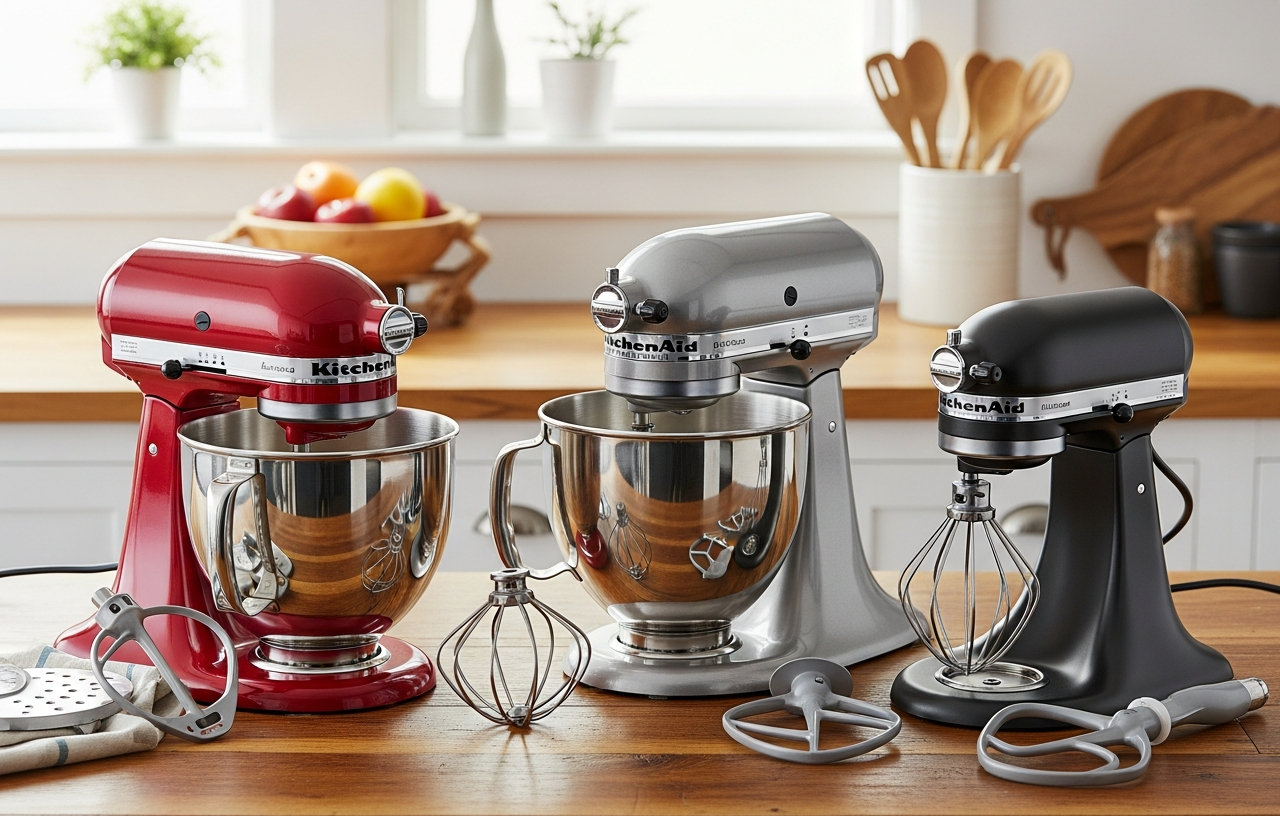
The KitchenAid Artisan Series 5 Quart Tilt Head Stand Mixer is a cornerstone for many kitchens, blending iconic design with robust functionality. It features a durable, built-to-last metal construction, providing excellent stability even when kneading heavy doughs. The mixer offers 59 touchpoints around the bowl, making sure ingredients are thoroughly incorporated. Its 5-quart stainless steel bowl with a comfortable handle is perfectly sized for both small and large batches, capable of mixing up to 9 dozen cookies in a single session. The tilt-head design simplifies adding ingredients and changing attachments, then locks securely in place during mixing. With 10 speeds, this mixer handles everything from gentle stirring to high-speed whipping, ensuring precise control for nearly any recipe.
Strengths:
- Durability: All-metal construction ensures a long lifespan.
- Versatility: The universal power hub accepts a vast array of KitchenAid attachments, expanding its utility far beyond basic mixing.
- Mixing Efficiency: The planetary mixing action with 59 touchpoints provides superior ingredient incorporation.
- Capacity: 5-quart bowl is ideal for most home baking tasks.
- Design: Classic aesthetic available in numerous colors.
Weaknesses:
- Motor Wattage: While sufficient for most tasks, its 325-watt motor is lower than some competitors, which might be a minor consideration for extremely dense, large doughs.
This mixer is best for serious home bakers who value durability, versatility through attachments, and consistent performance. It's a long term investment that adapts to evolving culinary interests.
Explore the full KitchenAid Artisan Stand Mixer Review for more details.
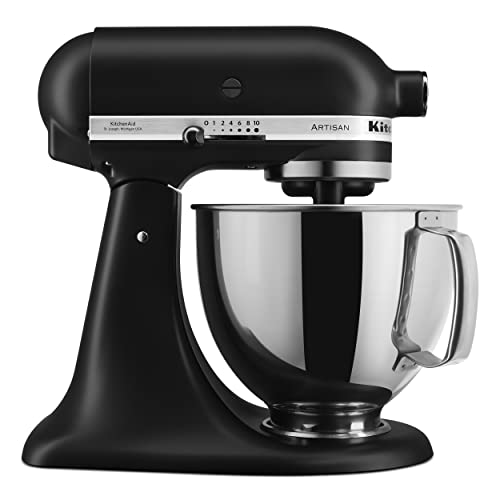
- Built to take it all on with the durable and built-to-last metal construction, and 59 touchpoints around the mixer bowl for great mixing results.. 5 Quart Stainless Steel Bowl with comfortable handle for small or large batches, to mix up 9 dozen cookies* in a single batch. Dishwasher safe. *Using the flat beater; 28g dough each.. Easily add ingredients with the tilt-head design, because you'll have better access to the bowl - lock the head in place while mixing.. 10 speeds for nearly any task or recipe, from mixing ingredients together on the stir speed, to whipping cream at speed 8, you'll get thorough ingredient incorporation every time.
KitchenAid Classic Series 4.5 Quart Tilt-Head Stand Mixer K45SS
The KitchenAid Classic Series 4.5 Quart Tilt-Head Stand Mixer offers the fundamental reliability and performance expected from the brand in a slightly more compact form. Like its Artisan counterpart, it features durable, built-to-last metal construction and 59 touchpoints for effective mixing. The 4.5-quart stainless steel bowl accommodates up to 8 dozen cookies in one batch. Its tilt-head design provides easy access to the bowl, and the head locks securely during operation. With 10 speeds, it handles a wide range of recipes, from light batters to heavier doughs. This model is a solid entry point into the KitchenAid ecosystem.
Strengths:
- KitchenAid Quality: Shares the durable metal construction and planetary mixing action of other KitchenAid models.
- Universal Hub: Compatible with all KitchenAid power hub attachments, offering significant expandability.
- Compact Size: Slightly smaller footprint than the Artisan, suitable for kitchens with less counter space.
Weaknesses:
- Smaller Capacity: The 4.5-quart bowl is a bit smaller, potentially requiring more batches for very large recipes.
- Lower Wattage: Its 275-watt motor is the lowest among these KitchenAid options, though still capable for typical home use.
The KitchenAid Classic Series is an excellent choice for bakers who appreciate KitchenAid's quality and attachment versatility but have smaller kitchens, bake less frequently, or prefer a more budget-friendly option. It performs well for everyday tasks.
Compare more KitchenAid Stand Mixer models.
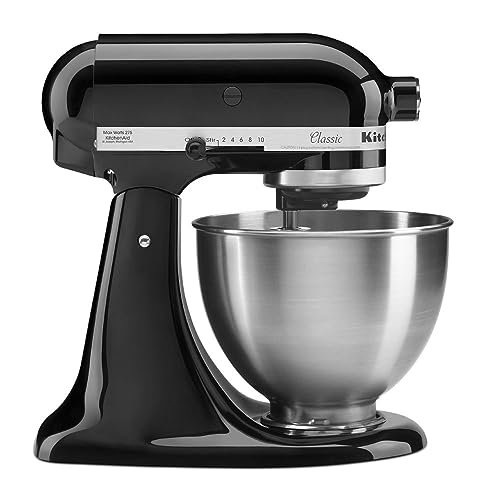
- Built to take it all on with the durable and built-to-last metal construction, and 59 touchpoints around the mixer bowl for great mixing results.. 4.5 Quart Stainless Steel Bowl to mix up to 8 dozen cookies in a single batch. Dishwasher safe. Using the flat beater; 28g dough each. Easily add ingredients with the tilt-head design, because you'll have better access to the bowl - lock the head in place while mixing. 10 speeds for nearly any task or recipe, from mixing ingredients together on the stir speed, to whipping cream at speed 8, you'll get thorough ingredient incorporation every time
Cuisinart SM-50FR 5.5-Quart Stand Mixer
The Cuisinart SM-50FR 5.5-Quart Stand Mixer presents a compelling alternative for those considering a cuisinart stand mixer vs kitchenaid stand mixer. It boasts a powerful 500-watt motor, capable of handling demanding mixing tasks with ease. The mixer features a large 5.5-quart polished stainless steel bowl, providing ample room for substantial recipes. Its die-cast metal construction adds to its durability and stability on the counter. With 12 speeds, the SM-50FR offers precise control, from gently folding ingredients to rapidly whipping cream. The tilt-back head allows for easy access to the bowl, simplifying the process of adding ingredients or scraping the sides. It also includes one power outlet for optional attachments, though the range is not as extensive as KitchenAid's.
Strengths:
- High Wattage Motor: The 500-watt motor provides significant power, making it suitable for dense doughs and large batches.
- Large Capacity: 5.5-quart bowl offers more volume than standard KitchenAid tilt-head models.
- Precision Control: 12 speeds allow for fine-tuned mixing adjustments.
- Durable Construction: Die-cast metal components contribute to its sturdy build.
Weaknesses:
- Attachment Ecosystem: While it has an attachment outlet, the variety of available Cuisinart attachments is more limited compared to KitchenAid.
- Brand Recognition: Cuisinart has less historical presence in the stand mixer market than KitchenAid, though it is a reputable brand in general kitchen appliances.
This mixer is best for bakers who prioritize raw motor power and a larger bowl capacity, especially if they frequently work with heavy doughs or large quantities. It offers excellent performance for its core mixing functions.

- Large 5.5 - quart capacity, polished stainless steel bowl. Powerful 500 watt motor, Die cast metal construction. 12 speeds for precision mixing & tilt back head allows easy access to bowl. One Power outlet for optional attachments
Martha Stewart 5.3Qt Stand Mixer
For those exploring options beyond the direct KitchenAid versus Cuisinart stand mixer comparison, the Martha Stewart 5.3Qt Stand Mixer offers another choice in the tilt-head category. This mixer features a generous 5.3-quart stainless steel bowl, suitable for mixing large batches, including up to 9 dozen cookies or substantial amounts of dough and cake batter. It comes with three versatile attachments: a stainless steel whisk, a dough hook, and a flat beater with a silicone edge for thorough scraping. With 12 optimized speed settings, it provides precision control for various tasks, from gentle folding to powerful kneading. The tilt-head design ensures quick access to the bowl for adding ingredients or changing attachments. While it doesn't have a dedicated power hub for extensive attachments like KitchenAid, it serves as a capable core mixer.
Strengths:
- Large Capacity: 5.3-quart bowl handles significant volumes.
- Good Core Attachments: Includes essential attachments, with the silicone-edged beater being a useful addition.
- Multiple Speeds: 12 speeds offer fine control for different recipes.
Weaknesses:
- Limited Expandability: Does not feature a universal power hub for a wide range of additional attachments.
- Construction: While sturdy, it may use a higher proportion of plastic components compared to the all-metal KitchenAid models.
This mixer suits bakers looking for a capable, large-capacity stand mixer primarily for core mixing tasks, without the need for an extensive attachment ecosystem. It offers good value for its features.

- 5.3QT STAINLESS STEEL BOWL: The polished 5.3-quart capacity easily handles large batches: mix dough, cake batter, and up to 9 dozen cookies with ease. 3 VERSATILE ATTACHMENTS: Includes a stainless steel whisk, dough hook, and flat beater with silicone edge for efficient, thorough mixing. 12 OPTIMIZED SPEED SETTINGS: Precision control lets you gently fold, thoroughly mix, or power through thick doughs for flawless results. TILT-HEAD DESIGN: Quickly access the bowl for adding ingredients, scraping sides, changing attachments, or checking progress
Choosing Your Mixer: KitchenAid or Cuisinart Stand Mixer?
Deciding between a KitchenAid mixer vs Cuisinart mixer depends on your priorities. Both brands offer reliable stand mixers, but they cater to slightly different needs.
When to Choose KitchenAid
You should lean towards a KitchenAid stand mixer if:
- You value versatility: The extensive range of KitchenAid attachments transforms the mixer into a multi-functional appliance. If you envision making pasta, grinding meat, or spiralizing vegetables with your mixer, KitchenAid is unmatched.
- You prioritize long term durability: KitchenAid's all-metal construction is built to last for decades, often becoming a generational kitchen tool.
- You want consistent performance: The planetary mixing action and reliable AC motors deliver thorough mixing results across various tasks.
- You prefer a classic aesthetic: KitchenAid's iconic design and wide color selection are appealing to many.
The KitchenAid Artisan Series is the best overall choice for most home bakers, offering a strong balance of features and expandability. For those with slightly less counter space or smaller batch needs, the KitchenAid Classic Series is a dependable entry point.
Understand the differences between KitchenAid Artisan vs Professional models.
When to Choose Cuisinart
Consider a Cuisinart stand mixer if:
- You need raw power: The 500-watt motor of the Cuisinart SM-50FR can be a significant advantage for frequently working with very stiff doughs, such as dense bread or bagel dough, or for mixing very large quantities.
- You prefer a larger bowl capacity: The 5.5-quart bowl offers more room, which can be beneficial for big baking projects.
- Your primary focus is core mixing: If you mainly need a powerful machine for mixing, kneading, and whipping, and don't anticipate buying a wide array of specialized attachments, the Cuisinart is a strong performer.
Attachments and Expandability
The expandability of your stand mixer is a significant factor in its long term utility. KitchenAid's universal power hub is a distinct advantage in this regard. This single hub at the front of the mixer can power over a dozen different attachments, effectively turning your stand mixer into a versatile kitchen center. Examples include the KitchenAid pasta roller, meat grinder, ice cream maker, and spiralizer. This extensive ecosystem makes the initial investment in a KitchenAid mixer more valuable over time, as it can replace several single-purpose appliances.
Cuisinart also offers some attachments for its mixers, such as pasta rollers or meat grinders, which connect to a power outlet on the mixer. However, the selection is generally not as broad as KitchenAid's. If exploring diverse culinary hobbies with attachments is a priority, the KitchenAid ecosystem provides more options.
Discover the best KitchenAid Attachments.
Maintenance and Care for Your Stand Mixer
Proper care extends the life of any stand mixer, whether it's a KitchenAid or a Cuisinart. Always unplug the mixer before cleaning. Most stainless steel bowls, flat beaters, and dough hooks are dishwasher safe. Wire whips often require hand washing to maintain their shape and finish. Wipe down the mixer's base with a damp cloth, avoiding abrasive cleaners. Make sure the head is locked securely before operation to prevent wobbling and potential damage. Regularly checking the attachment hub for any food residue also helps maintain its functionality.
Learn How to Use a Stand Mixer effectively.
Final Thoughts on Cuisinart Versus KitchenAid Stand Mixer
When weighing a Cuisinart versus KitchenAid stand mixer, both brands offer quality appliances capable of handling typical home baking tasks. KitchenAid holds an edge in its proven durability, extensive attachment ecosystem, and classic design. The KitchenAid Artisan Series 5 Quart Tilt Head Stand Mixer remains the top recommendation for its versatility and robust performance. Cuisinart provides a powerful alternative, particularly appealing if a higher wattage motor and slightly larger bowl are your primary considerations. Ultimately, the best choice aligns with your specific baking needs, desired features, and how you envision using your stand mixer beyond basic mixing.
Read our Stand Mixer Buying Guide for more insights.